Tattoo Machine Stroke Length Explained: 2.5 mm to 5 mm
Short answer
What stroke length should a tattoo machine have?
Stroke length is the distance the needle travels on each cycle, and it sets how hard the machine hits. Typically, short strokes around 2.4 to 3.0 mm suit soft shading and fine work, about 3.3 to 3.6 mm is the all-rounder, and 4.0 to 5.0 mm suits bold lining and heavy packing. PMU machines run shorter, about 2.2 to 3.4 mm.
Key takeaways
- A longer stroke drives the needle further and harder; a shorter stroke is softer and smoother but slower to saturate.
- Around 3.5 mm is the common all-round stroke for one-machine setups.
- Manufacturers name their strokes by job: Bishop sells the Power Wand as Shader 3.5 mm, Packer 4.2 mm and Liner 5.0 mm.
- Stroke is not needle depth: depth is set by how far the needle protrudes, stroke by the machine's cam.
- Adjustable machines such as the FK One Adjust (2.0 to 5.0 mm) let one machine cover every range.
On this page 7 sections
Stroke length is the one spec that changes what a machine is for, which is why the same model is often sold in three strokes. If you buy the wrong stroke, a good machine feels wrong: too harsh for soft shading, or too soft to put a line in cleanly. Here is what stroke does, the ranges manufacturers recommend for each job, and when an adjustable machine makes sense. Published by Miami Tattoo Supplies (MTS), whose tattoo machine collection lists the stroke of every version.
What is stroke length?
Stroke length is how far the needle moves from its highest to its lowest point in one cycle, measured in millimeters. On a rotary it is set by the cam or eccentric on the motor: a bigger offset moves the needle further. On a coil machine it depends on the armature travel and contact gap.
A longer stroke means the needle travels further and arrives with more force, so it puts ink in with fewer passes and holds a line well. A shorter stroke travels less, so it is gentler on skin and smoother for gradual shading, but it takes more passes to saturate.
What stroke length should you use?
There is no universal rule; these are common ranges drawn from how manufacturers label their own strokes. Your hand speed, needle grouping, voltage and the client's skin all change the result.
| Stroke | Commonly used for | Manufacturer examples |
|---|---|---|
| About 2.2–3.0 mm | PMU, fine line, soft shading, whip shading | Microbeau E.L.B. 2.2–3.4 mm (PMU); Emalla 2.4–3.0 mm "soft shading" |
| About 3.0–3.6 mm | Black-and-grey shading, all-round work | Bishop Shader 3.5 mm; FK Flux Max 3.2 mm; Emalla 3.3–3.6 mm "sweet spot" |
| About 3.7–4.2 mm | Lining, color packing | Bishop Packer 4.2 mm; FK Flux Max 4.0 mm; Emalla 3.9–4.2 mm "bold lining" |
| About 4.5–5.0 mm | Bold traditional lines, heavy packing, blackout | Bishop Liner 5.0 mm; FK Flux Max 4.5 mm |
Two points stand out. First, manufacturers draw the lines differently: Bishop makes its 5.0 mm Power Wand the Liner, for all line work, 3RL shading, blackwork and dotwork, and its 3.5 mm Shader for smooth black-and-grey and fine line, while Emalla puts bold lining at 3.9 to 4.2 mm on the G5 Pro. Both approaches work; they reflect different motors and different ideas of a line. Second, fine-line artists often line with short strokes, because they are pulling small, light lines, not bold ones. See best needles for fine line and how to line a tattoo.
Why is 3.5 mm called the all-rounder?
Because it is long enough to line and pack and short enough to shade without chewing skin. That is why many single-stroke machines sit around there: the Mast Tour is a fixed 3.5 mm pen that its listing pitches for line work, black-and-grey shading and solid color packing, and Bishop's Shader and Emalla's fixed-stroke Grand G5 also come in 3.5 mm. If you can only own one fixed-stroke machine, a mid-range stroke is the safe choice.
How does stroke interact with voltage and give?
They work together. A longer stroke moves more needle per cycle and loads the motor more, while voltage (or hertz) sets how fast the cycles come. Many artists run a short stroke a little faster for smooth shading and a long stroke slower for packing, but FK Irons' own guidance is that the right voltage is whatever your technique, stroke and tuning require. Electronic "give" settings, like FK Irons' eGive or Emalla's E-Soft, soften the hit further without changing the stroke; see soft vs hard hit. The voltage guide covers dialing in.
Is stroke the same as needle depth?
No. Stroke is how far the needle travels; depth is how far the needle tip extends past the cartridge tip at the bottom of the stroke, set by the needle hang or the depth dial. You can run a long stroke with a short hang and vice versa. Depth is covered in how deep a tattoo needle should go.
Fixed or adjustable stroke?
Fixed-stroke machines are simpler and you always know what you are holding; most specialists own two or three. Adjustable machines let one body do everything:
- FK One Adjust: 2.0 to 5.0 mm in 0.5 mm steps, adjustable without powering down (FK Irons).
- Emalla Grand G5 Pro: seven steps, 2.4 to 4.2 mm, switchable on the fly (Emalla).
For PMU, the Microbeau E.L.B. from FK Irons adjusts from 2.2 to 3.4 mm, with suggested settings of 2.2 to 2.8 mm for brows, 2.2 to 2.5 mm for eyeliner and 2.8 to 3.4 mm for lips, per its MTS listing. More in PMU machine vs tattoo machine.
The FK Irons machines at Miami Tattoo Supplies are listed by stroke, and the Bishop Power Wand guide explains its three strokes.
Watch
Gear mentioned
Products from the Miami Tattoo Supplies catalog, the publisher of this site. Check current price and stock on the store.
FK Irons
FK One Adjust Wireless Tattoo Machine
View at Miami Tattoo Supplies: FK One Adjust Wireless Tattoo Machine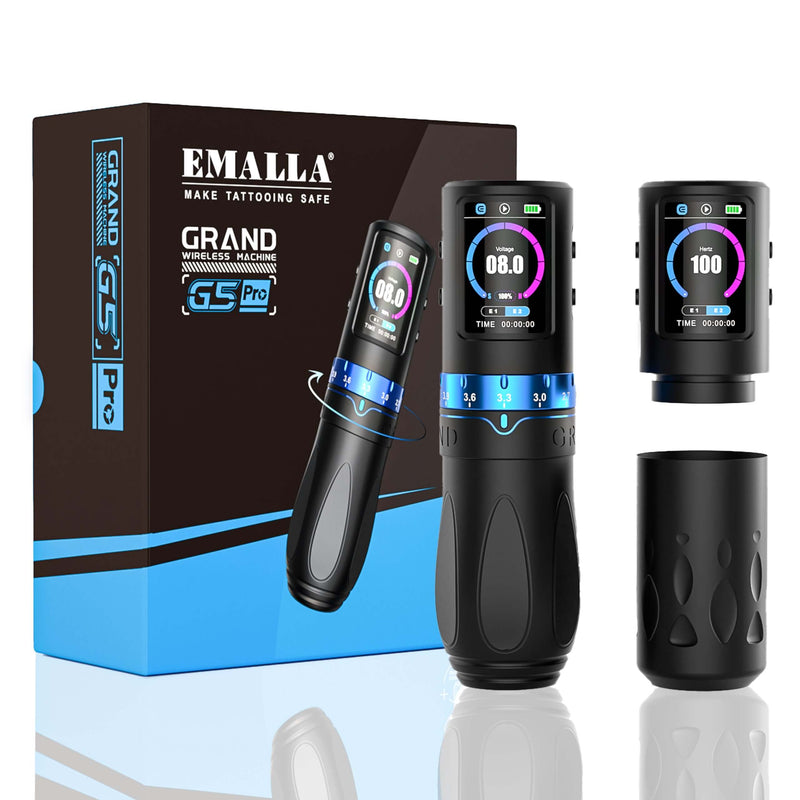
Emalla
EMALLA Grand G5 Pro Wireless Tattoo Pen Machine (Adjustable Strokes)
View at Miami Tattoo Supplies: EMALLA Grand G5 Pro Wireless Tattoo Pen Machine (Adjustable Strokes)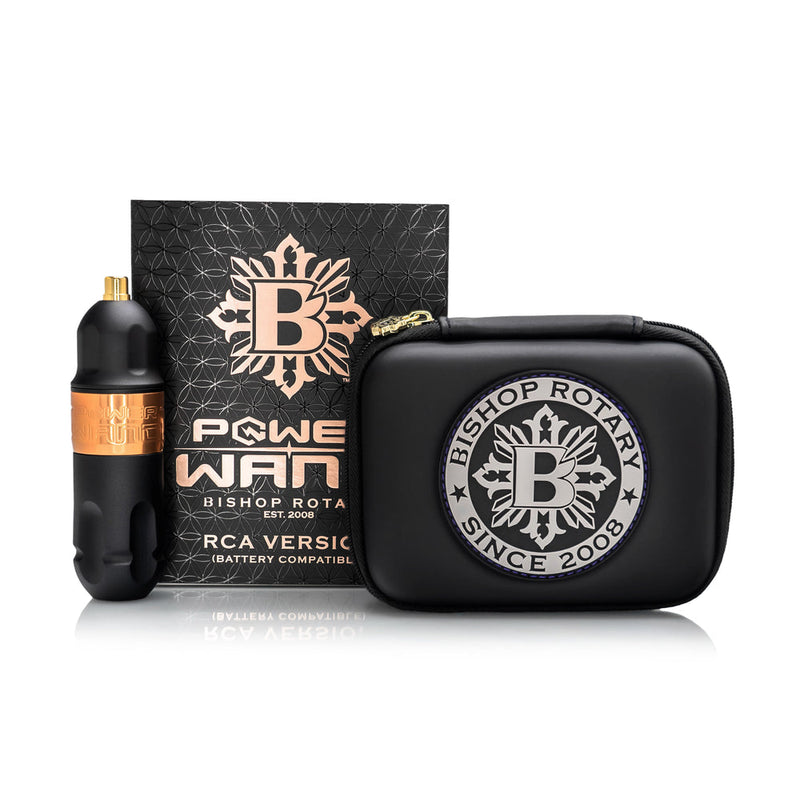
FK Irons
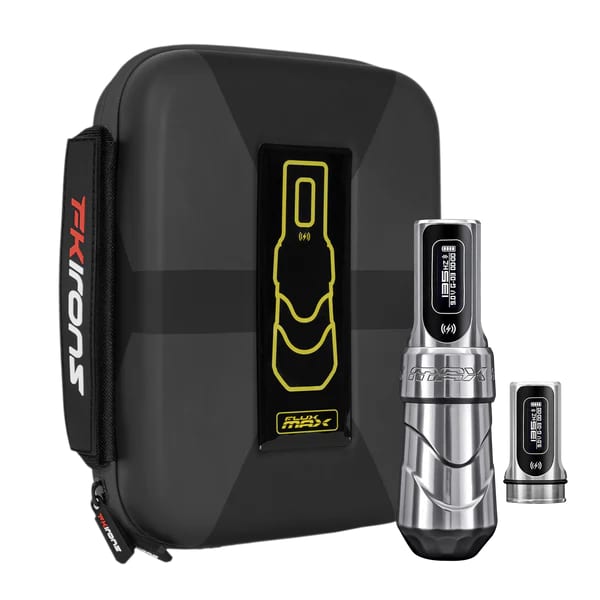
FK Irons Flux Max Blade w/ 2 PowerBolts II
View at Miami Tattoo Supplies: FK Irons Flux Max Blade w/ 2 PowerBolts II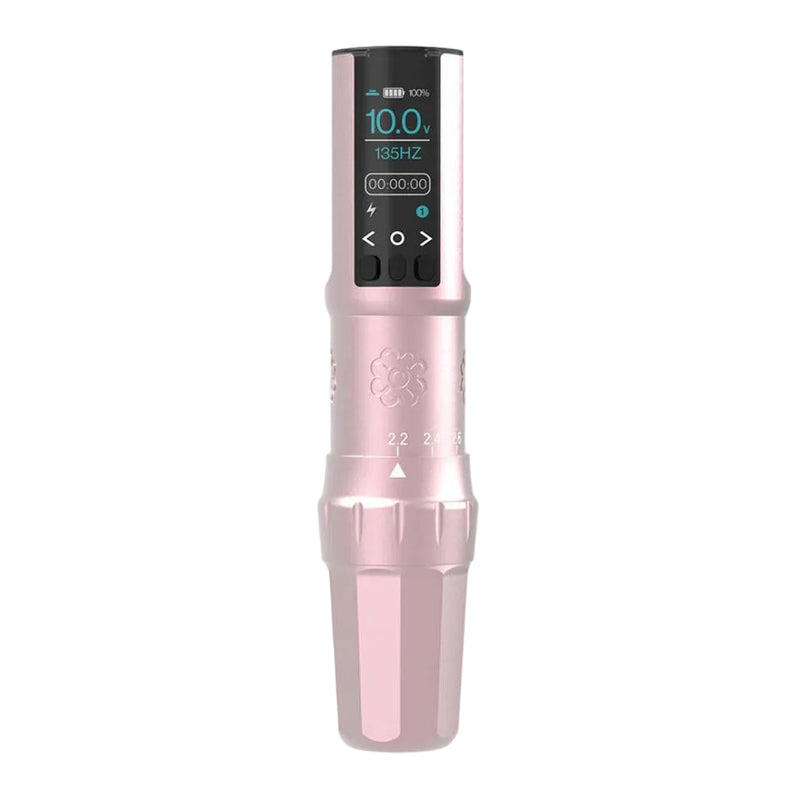
FK Irons
Microbeau E.L.B. Adjustable Stroke PMU Machine
View at Miami Tattoo Supplies: Microbeau E.L.B. Adjustable Stroke PMU Machine
Frequently asked questions
What stroke length is best for lining?
Commonly 3.9 to 5.0 mm for bold lines, depending on the brand: Bishop's Power Wand Liner is 5.0 mm, the Flux Max comes in 4.0 and 4.5 mm for heavier work, and Emalla suggests 3.9 to 4.2 mm. For fine-line work, many artists use shorter strokes around 2.5 to 3.0 mm. Your needle grouping and hand speed matter as much.
What stroke length is best for shading?
Short to mid strokes, roughly 2.4 to 3.6 mm, are commonly used for soft and black-and-grey shading because they are gentler and smoother. Bishop sells its Power Wand Shader at 3.5 mm; Emalla recommends 2.4 to 3.0 mm for soft gradients. Heavy black shading and blackout often go longer.
Does a longer stroke hurt more?
It hits harder, so used badly it can cause more trauma. In practice, damage depends more on voltage, hand speed, needle depth and how many passes you make. A long stroke used correctly can heal better than a short stroke overworked to get ink in.
Can I change the stroke on a fixed-stroke machine?
Usually not; you buy the other version. A few machines are built with interchangeable cams, and FK Irons lists one of its corded models with a swappable 3.2 or 3.7 mm cam. Never open a sealed machine to swap parts unless the manufacturer supports it: Bishop, for one, voids its warranty if you open the motor yourself.
What stroke do PMU machines use?
Shorter than most tattoo machines. The Microbeau E.L.B. adjusts from 2.2 to 3.4 mm, with 2.2 to 2.5 mm suggested for eyeliner and 2.8 to 3.4 mm for lips. PMU deposits pigment more shallowly and in finer detail, so a softer stroke is the norm. Follow the machine maker's guidance for each procedure.