
Rotary vs Coil Tattoo Machines: Which Should You Buy?
Short answer
What is the difference between rotary and coil tattoo machines?
A coil machine moves the needle with electromagnets that pull an armature bar down against a spring, giving a hard, snappy hit that you tune with springs and a contact screw. A rotary uses an electric motor and cam for a smoother, quieter stroke with little tuning. Most artists today, and every beginner, are better served by a rotary; coils remain a choice for traditional work.
Key takeaways
- Coils are tuned by hand (springs, contact screw, armature gap), so the same machine can feel different after a rebuild; rotaries run the same way out of the box.
- Coils are louder and usually heavier; rotaries are quieter, vibrate less and are easier to bag.
- A coil is usually built as either a liner or a shader; most rotaries cover more ground, and adjustable-stroke rotaries cover everything.
- Rotaries run standard cartridges directly and include all wireless pens; coils mostly run needles on bar in tubes.
- Miami Tattoo Supplies sells rotary machines only at the time of writing (November 2026).
On this page 9 sections
Both machines do the same job: push a needle in and out of skin many times a second. The difference is how, and that changes how the machine feels in your hand, how much time you spend tuning it, and what it does well. This comparison is written by Miami Tattoo Supplies (MTS), which sells rotary tattoo machines, so it says plainly where coils still win.
How does a coil tattoo machine work?
A coil machine is an electromagnetic circuit that switches itself on and off. Current flows through two wire-wrapped coils, which become magnets and pull a steel armature bar down. That movement breaks contact between the front spring and the contact screw, the magnets switch off, and the spring snaps the bar back up, which closes the circuit again. The needle bar is attached to the armature, so each cycle is one needle stroke.
Everything about the hit depends on the build: coil wraps, spring gauge, armature weight, the gap at the contact screw. That is why coil artists talk about "tuning" and why a liner and a shader coil are built differently.
How does a rotary tattoo machine work?
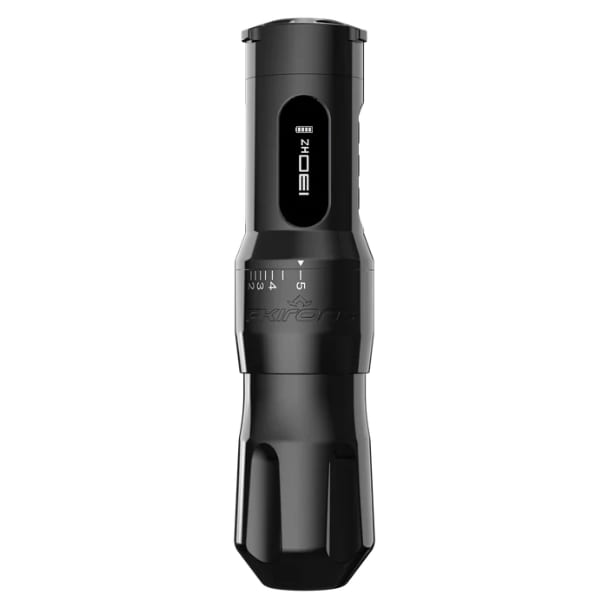
A rotary uses a small electric motor. A cam or eccentric on the motor shaft converts rotation into up-and-down movement, either pushing the needle directly (direct drive), through a slider, or through a linkage inside a pen-shaped body. The stroke length is set by the cam: fixed on most machines, adjustable on machines like the FK One Adjust (2.0 to 5.0 mm, per FK Irons). There is no spring to tune and no contact point to burn. The pen machine guide explains the rotary sub-types.
Rotary vs coil at a glance
| Coil | Rotary | |
|---|---|---|
| Mechanism | Electromagnets, armature bar, springs | Electric motor and cam |
| Hit | Hard, snappy, adjustable by tuning | Smoother, consistent; "give" on some models |
| Noise and vibration | Loud buzz, noticeable vibration | Quiet hum, low vibration |
| Setup | Tuning, springs, contact screw, tubes | Little or none; cartridge in, power on |
| Versatility | Usually built as liner or shader | Wider range; adjustable stroke covers all |
| Wireless options | Few | Many (battery pens) |
How do they feel different?
Coils hit harder and faster to recover, which many traditional artists like for bold, single-pass lines and solid black. Rotaries feel smoother and more even, which suits soft shading, realism and long sessions. The gap has narrowed: some rotaries now simulate a coil's give electronically. FK Irons' eGive, for example, offers levels 0 to 3 on the PowerBolt II battery, and Emalla's E-Soft setting runs in 10 levels on the Grand G5 Pro. What give is and how it changes the hit is explained in soft vs hard hit.
Which is easier to maintain?
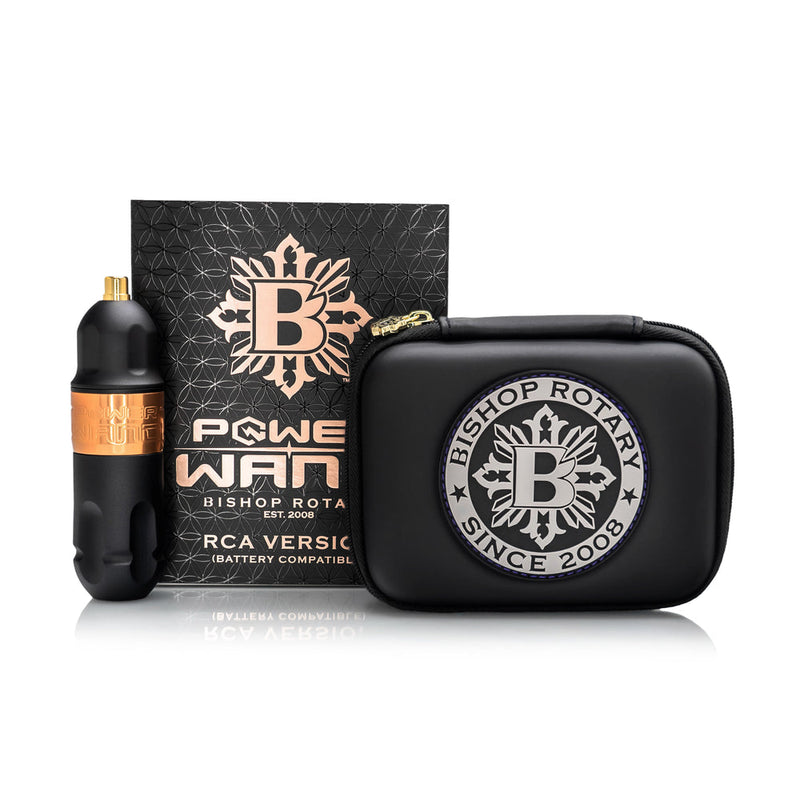
Rotaries, by a wide margin. A coil needs springs replaced, contact points kept clean, binding posts checked, and re-tuning when the hit drifts. A rotary needs the outside wiped and barriered, O-rings and grips replaced when worn, and the occasional manufacturer service. The Bishop Power Wand set, for instance, includes a tube of Krytox lubricant, and Bishop's warranty is voided by over-lubrication, so follow the manufacturer rather than habit. The machine cleaning guide has the routine.
Weight, noise and power
Coil machines are usually heavier, with iron or steel frames and the coils themselves at the front. The pens discussed on this site range from 82 g (the Mast Tour, per its listing) to 268 g (the FK One Adjust with its longer battery, per FK Irons). Coils are loud enough that clients notice; rotaries are close to silent.
Both machine types run from a regulated DC power supply with a foot pedal or, for rotaries, a battery. In common practice coils are run at higher voltage than rotaries, while FK Irons, for its rotaries, recommends between 5 and 9 volts depending on the job. The voltage guide explains how to find your setting.
Who still runs coil machines, and why?
Traditional and neo-traditional tattooers make up much of the coil crowd. They like the hard hit for bold lines and the punch for solid black, and many enjoy building and tuning their own machines. Some artists keep a coil liner alongside a rotary for everything else. If you learned on coils from a mentor who tunes them, there is no reason to stop.
Who should not start on coils: beginners without a mentor who runs them. A badly tuned coil teaches bad habits and chews skin.
Which should you buy?
Buy a rotary unless you have a specific reason not to. It is easier to learn, easier to maintain, quieter for clients, and the only route to wireless pens. Buy a coil if your style is traditional, your mentor runs coils, or you want to learn machine tuning as a craft. For a first rotary, the best tattoo machines of 2026 compares the main options by job.
At the time of writing, Miami Tattoo Supplies lists rotary machines only; the tattoo machine collection covers FK Irons, Bishop, Emalla and Mast. For corded rotaries or a coil you already own, the power supply range includes the Salvation dual-input supply, which has separate liner and shader voltage dials.
Gear mentioned
Products from the Miami Tattoo Supplies catalog, the publisher of this site. Check current price and stock on the store.
FK Irons
FK One Adjust Wireless Tattoo Machine
View at Miami Tattoo Supplies: FK One Adjust Wireless Tattoo Machine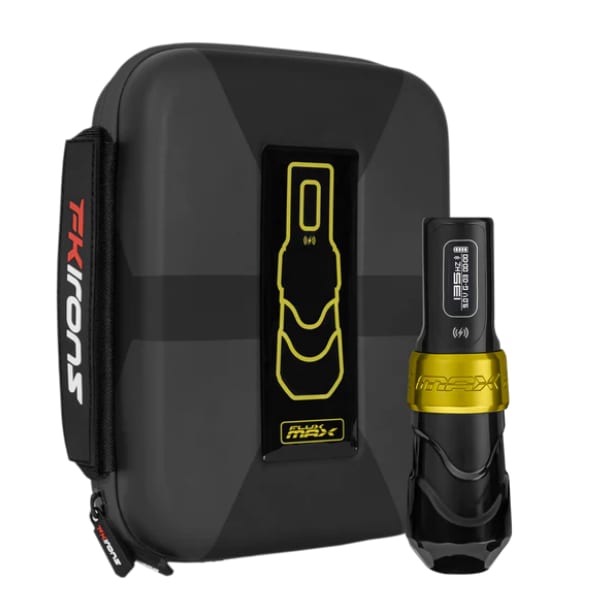
FK Irons
FK Irons Flux Max Gold Stealth w/ 1 PowerBolt II
View at Miami Tattoo Supplies: FK Irons Flux Max Gold Stealth w/ 1 PowerBolt II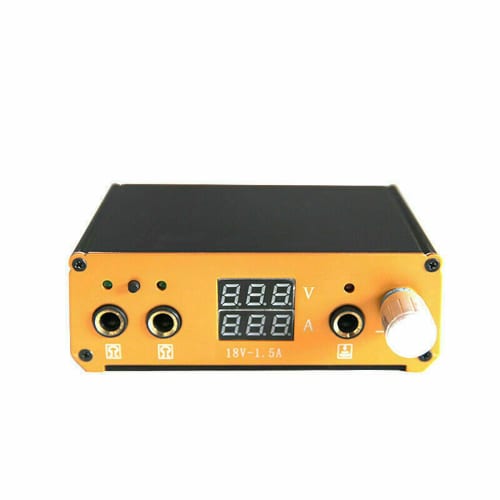
Salvation Dual Input Digital Power Supply
View at Miami Tattoo Supplies: Salvation Dual Input Digital Power Supply
Frequently asked questions
Are coil tattoo machines better for lining?
Many traditional artists think so, because a well-tuned coil liner snaps the needle through the skin quickly and makes bold lines in one pass. A rotary with a longer stroke, such as the 4.5 mm Flux Max or 5.0 mm Power Wand Liner, lines just as cleanly for most artists. It comes down to style and training rather than one being objectively better.
Do coil machines hurt clients more than rotaries?
Not necessarily. Trauma depends far more on the artist's hand speed, needle depth, voltage and number of passes than on the machine type. A badly tuned coil can be harsh, and a rotary run too hard can be just as rough. Technique is the main factor.
Can a coil machine use cartridges?
Yes, with a cartridge grip or adapter made for coil machines, but it is not the standard setup. Most coils run needles on bar through tubes. If you want cartridges with no adapters, a rotary or pen machine is the simpler choice.
Why are coil machines so loud?
The buzz is the armature bar striking and the contact point opening and closing many times a second. That sound is part of the appeal for some artists. Rotary motors spin continuously, so they hum instead of buzzing.
Can I run a coil and a rotary from the same power supply?
Yes, if the supply has the right connections and you adjust the voltage when you switch. Dual-output supplies let you set separate voltages for a liner and a shader. Coils usually connect with a clip cord; most rotaries use RCA.