
Wireless Tattoo Machines: Are They Worth It?
Short answer
Are wireless tattoo machines worth it?
For most full-time artists, yes. A wireless machine removes cord drag, speeds setup and leaves less to bag, at the cost of battery weight, spare batteries and charging routine. Manufacturer runtimes range from about 4 to 10 hours per charge depending on battery, voltage and needle. If you already own a good RCA machine, a universal battery pack is the cheaper way to go wireless.
Key takeaways
- Runtime always depends on voltage, stroke and needle grouping; treat manufacturer figures as best-case.
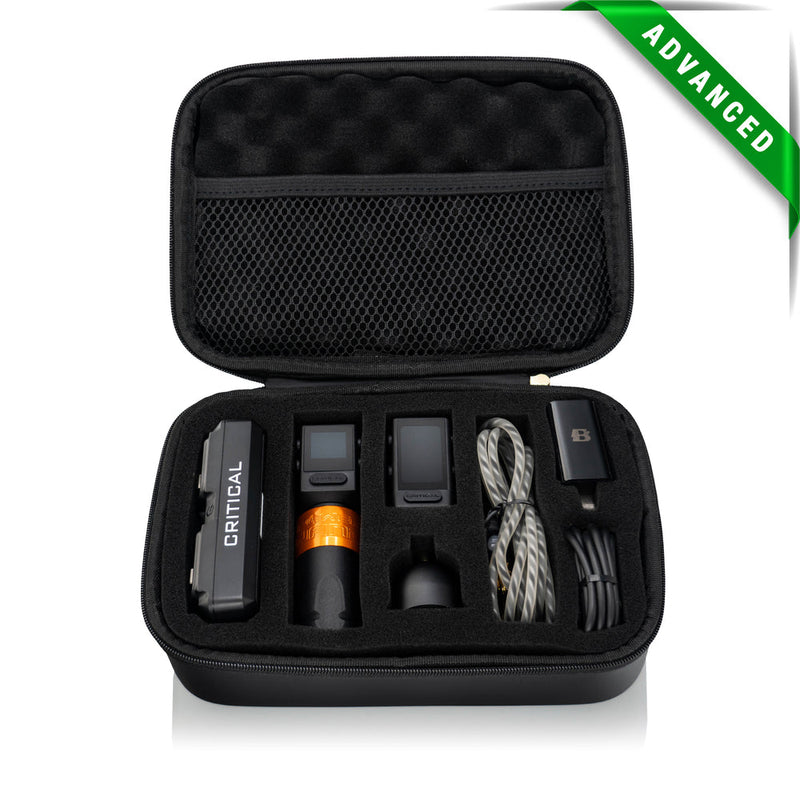
- Three designs exist: detachable battery packs (FK PowerBolt II, Bishop Advanced), drop-in internal batteries (FK One Adjust), and universal RCA packs that make a corded rotary wireless.
- Always own at least two batteries, so one charges while the other runs.
- A battery on the back of a pen shifts the balance rearward; try the machine with its battery fitted.
On this page 7 sections
Wireless machines went from novelty to default in a few years, and the question now is less "do they work" than "is the extra cost worth it for how I tattoo". The honest answer depends on how many hours you put in, whether you already own a good corded machine, and how disciplined you are about charging. This guide uses manufacturers' own runtime figures. It is published by Miami Tattoo Supplies (MTS), which sells the machines and batteries named; the machines in stock at MTS are nearly all wireless.
What do you gain by going wireless?
Freedom of movement and a faster, cleaner setup. With no clip cord or RCA cable, nothing pulls on the back of the machine, nothing drags across the client, and there is one less item to sleeve and bag. Moving around a client during a large piece, or working at conventions and guest spots, is noticeably easier. Many wireless batteries also show voltage, battery level and session time on the machine, which corded setups put on a separate supply.
What do you give up?
Weight, money and some routine. A battery adds mass at the back of the machine, which changes the balance. Wireless machines cost more than their RCA versions, spare batteries are expensive, and a battery that dies mid-line is a real interruption if you have no spare charged. Batteries also wear with charge cycles.
How long do wireless tattoo batteries last?
Between about 4 and 10 hours per charge on the manufacturers' figures, always "depending on use". Every brand states that runtime falls with higher voltage, longer stroke and bigger needle groupings, so a day of packing with large magnums will drain a battery far faster than fine lining.
| Machine or battery | Battery type | Manufacturer runtime |
|---|---|---|
| FK Irons Flux Max | Detachable PowerBolt II | Up to 6 hours |
| FK One Adjust | Two drop-in Panasonic cells | About 5.5 h (18500A) / 6.5 h (18650A) |
| Bishop Power Wand Advanced | Advanced battery (standard or Shorty) | Up to 6 h standard / 4 h Shorty |
| Bishop Power Wand XLUMEN | Two 2,300 mAh XLUMEN batteries | Not published |
| Emalla Grand G5 Pro | Two 2,000 mAh packs | About 10 hours combined (6–8 h per battery) |
Sources: FK Irons, Bishop and Emalla product and comparison pages. Emalla notes its single-battery figure was measured without needle load, so expect less in real work.
The three kinds of wireless setup
Detachable battery packs
The battery clicks or snaps onto the back of the machine and swaps in seconds. FK Irons' PowerBolt II fits the Flux Max, EXO and Flux, and charges fully in 2 hours over USB-C according to FK Irons. Bishop's Power Wand takes its battery on a magnetic backplate that lets it rotate 360 degrees; Bishop sells a standard and a shorter "Shorty" battery, states the Power Wand is 4.4 in and 5.2 oz with the Shorty fitted, and gives the Advanced battery two voltage presets and a jumpstart setting. The Emalla Grand G5 Pro also uses detachable packs and ships with two.
Drop-in internal batteries
The FK One Adjust takes cylindrical Panasonic cells inside the body, closed with a cap. It ships with two batteries and two caps (short and long), so you choose between a lighter machine (244 g with the 18500A) and a longer runtime (268 g with the 18650A).
Universal RCA battery packs
A universal pack plugs into the RCA socket of a corded rotary and turns it into a wireless machine. It is the cheaper route if your corded machine already suits you. The RCA battery pack at MTS ($79 at the time of writing) is listed with a 2,400 mAh cell and five output levels from 5 to 11 V; check that its levels cover the voltage your machine runs at. Expect extra length and weight at the back of the machine compared with a built-in battery.
Who should go wireless?
Full-time artists, travelling artists and anyone doing long sessions benefit most. Artists who tattoo occasionally, or who already own a reliable corded machine and supply, can stay corded or add a universal battery for less. Very light pen users should check that the battery weight does not spoil the balance they bought the machine for.
Wireless is also not automatically better for beginners. A corded machine on a basic supply teaches the same skills, and battery management is one more thing to get wrong. See our beginner machine guide.
What it costs at Miami Tattoo Supplies
At the time of writing (November 2026): the FK Irons Flux Max is $849 with one PowerBolt II and $999 with two; the FK One Adjust is $799.99 with two batteries; the Bishop Power Wand with Advanced Battery full set is $1,199.99 and the XLUMEN, with two batteries, $1,299.99; the Emalla Grand G5 Pro is $429 with two batteries; and the Mast Tour is $169 with its battery. The two-battery Flux Max is the cheaper way to get a spare: FK Irons lists a PowerBolt II on its own at $299.99. The power supplies and batteries collection holds spare batteries and RCA packs. For deeper reads, see the Flux Max guide, the Bishop Power Wand guide and the power supply guide.
Watch
Gear mentioned
Products from the Miami Tattoo Supplies catalog, the publisher of this site. Check current price and stock on the store.
Bishop
Bishop Power Wand with Advanced Battery - Full Set
View at Miami Tattoo Supplies: Bishop Power Wand with Advanced Battery - Full Set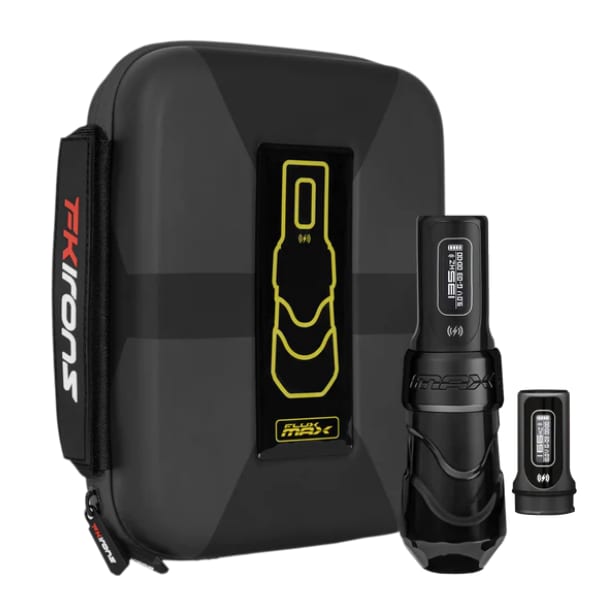
FK Irons
FK Irons Flux Max Stealth w/ 2 PowerBolts II
View at Miami Tattoo Supplies: FK Irons Flux Max Stealth w/ 2 PowerBolts II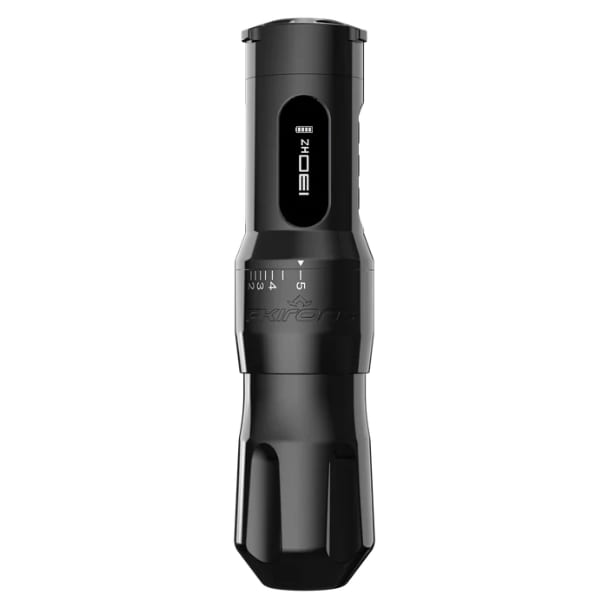
FK Irons
FK One Adjust Wireless Tattoo Machine
View at Miami Tattoo Supplies: FK One Adjust Wireless Tattoo Machine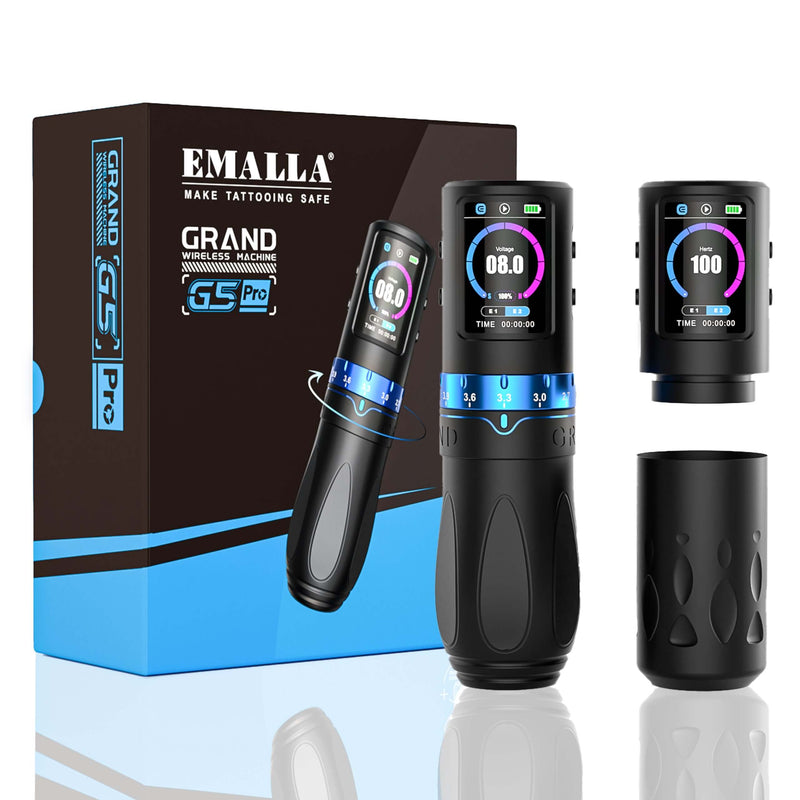
Emalla
EMALLA Grand G5 Pro Wireless Tattoo Pen Machine (Adjustable Strokes)
View at Miami Tattoo Supplies: EMALLA Grand G5 Pro Wireless Tattoo Pen Machine (Adjustable Strokes)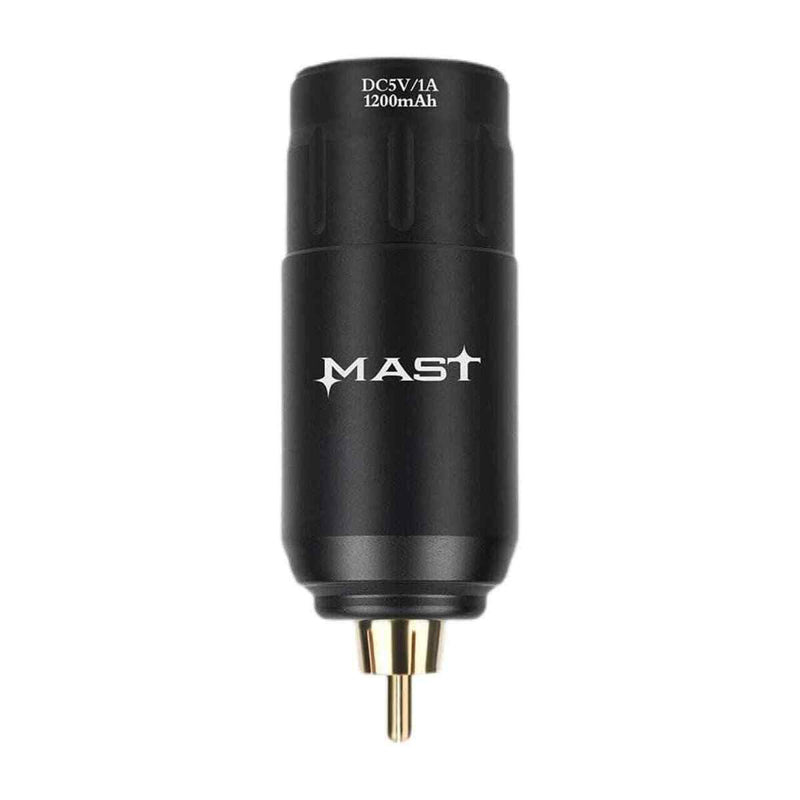
Frequently asked questions
Do wireless tattoo machines have less power than corded ones?
No, not in normal use. Wireless batteries deliver regulated voltage in the same range as a corded supply; FK Irons rates the Flux Max at 4 to 12 V, for example. Some batteries include a jumpstart feature to help motors start with large groupings. Power only becomes an issue when the battery is nearly flat.
Can I use any battery on any wireless machine?
No. Detachable batteries are brand-specific: PowerBolt II fits FK Irons wireless machines, and Bishop's XLUMEN and Power Wand Advanced batteries do not fit each other's machines. Universal packs work with corded machines that have a matching RCA socket. Always check the manufacturer's compatibility list.
Can I tattoo while the battery is charging?
Plan not to. Most systems are designed for you to swap to a second charged battery rather than run on the cable. Some machines can switch to an RCA module and run from a wired supply, such as the Emalla Grand G5 Pro. Check your manual before tattooing on a charging cable.
How long do tattoo machine batteries last before they need replacing?
Manufacturers do not publish a cycle life for most tattoo batteries, so there is no reliable number to quote. Like any lithium cell, capacity drops with age and charge cycles. When a full charge no longer gets you through a typical session, replace the battery rather than the machine.
Is a wireless machine more hygienic?
It removes the cord, which is one less surface to sleeve and one less item to drag across the work area. The machine itself still needs a barrier, disinfection between clients and a fresh cartridge. Wireless helps cross-contamination control, but it does not replace the routine.